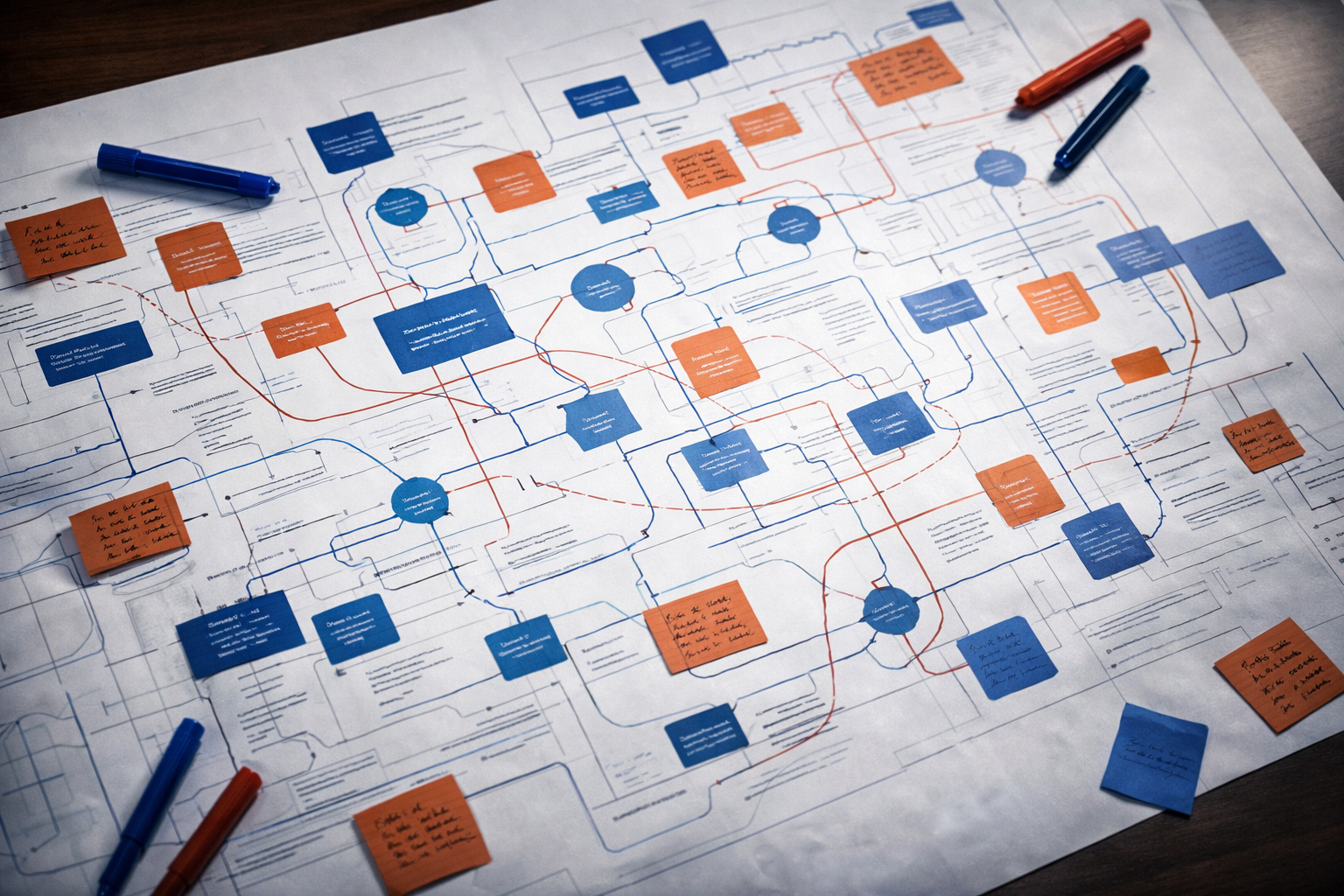
I don't build messaging. I build the logic structures that make your position defensible, repeatable, and capable of generating movement — before a single word is written.
Most communications failures aren't messaging failures. They're architecture failures. The position wasn't sound. The logic wasn't defensible. The story had no load-bearing walls.
My work starts with a discipline I call Decision-Grade Architecture — building the structural logic of a position before any message is shaped. A decision-grade narrative is one that holds up under the hardest questions from the most adversarial audiences, while remaining accessible enough to move an employee, a regulator, or a journalist in your direction.
The word "architecture" is deliberate. Buildings don't stand because of good materials alone. They stand because of the logic of how those materials are organized. The same is true of institutional communication.

Map the institutional complexity: stakeholder landscape, existing narrative assets and liabilities, the actual question your audiences are asking — which is rarely the question you think they're asking.
Build the logic framework — the structural narrative that organizes your position into "logic waves": a sequence of defensible claims that leads naturally from complexity to clarity, and from clarity to action.
Translate architecture into execution: message frameworks, executive materials, testimony, media positioning, stakeholder engagement, and the ongoing narrative management that sustains momentum.
The communications industry has a sequencing problem. Most consultants start with message development — what do we say? I start with position development — what do we believe, and why is that belief defensible?
The distinction matters most in high-stakes situations: regulatory proceedings, activist campaigns, board-level transformation debates, ESG scrutiny from institutional investors. In those environments, a message without architecture collapses under the first hard question.
"Once the architecture is defensible, the message writes itself. Before that point, no amount of wordsmithing will make it hold."Jim Woods
A focused, no-obligation conversation — typically 30 to 45 minutes. My goal is to understand your situation with enough precision to determine whether I can genuinely help, and to give you enough clarity that the call has value regardless of whether we proceed.
I don't take every engagement. The Clarity Call is how I determine fit — for both of us.
A comprehensive analysis of your current narrative position: existing assets and liabilities, stakeholder landscape, regulatory environment, media footprint, and the specific architecture gaps creating friction.
The Audit produces a written findings document with specific, actionable recommendations — the blueprint for the engagement that follows.
Active strategy deployment across the full arc of your challenge: message architecture, executive preparation, coalition building, stakeholder engagement, media strategy, and ongoing advisory.
Engagements are structured by outcome, not by hours. When the architecture is defensible and momentum is established, we transition to retainer or close.
I work with a small number of clients at any given time. That's a deliberate choice, not a capacity limitation.
I'm not the right fit for organizations that need volume production — press release factories, SEO content mills, or social media management. I'm brought in when the stakes are high enough that the wrong narrative carries real institutional risk.
My clients are typically C-suite executives and boards who have run out of room to be wrong, and who understand that the quality of their strategic communications is itself a competitive and reputational asset.
If that's your situation, the Clarity Call will tell us whether I'm the right person for it.
The Clarity Call is where I determine whether there's a genuine fit between your situation and my capabilities. No pitch. No proposal. Just clarity.
Schedule a Clarity Call